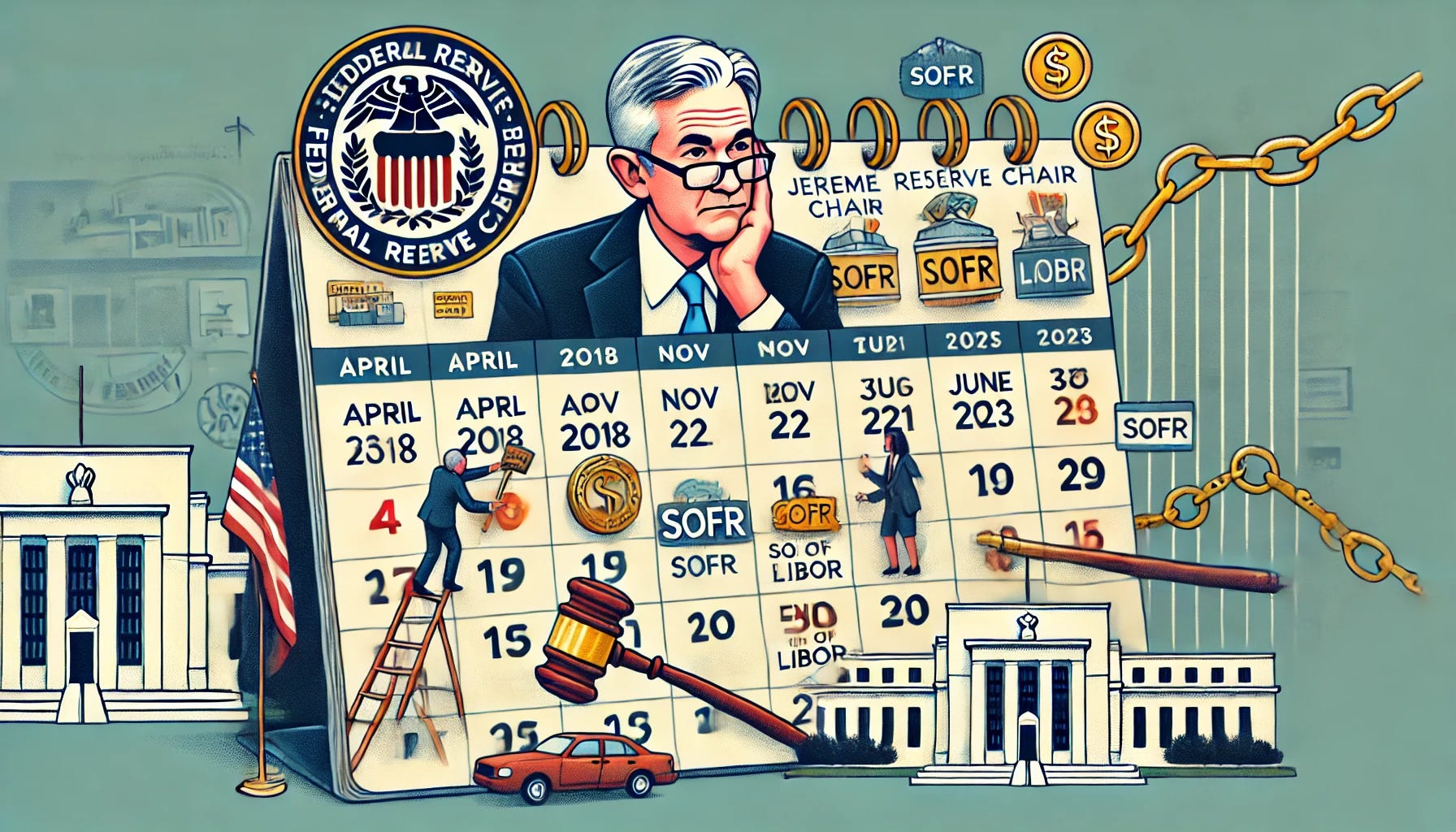
The Powell Timeline
Extremely noteworthy but overlooked

Jerome Powell's Federal Reserve Chair Nominations
2018
February 5: Jerome Powell is sworn in as the 16th Chair of the Federal Reserve, succeeding Janet Yellen. His nomination by President Donald Trump and confirmation by the Senate marked a significant leadership change at the Fed.
2021
February: Powell, as Chair, navigates the Federal Reserve through the economic impacts of the COVID-19 pandemic, implementing various measures to stabilize the economy.
November 22: President Joe Biden nominates Jerome Powell for a second term as Chair of the Federal Reserve, signaling continuity in monetary policy amidst economic recovery efforts. However, this decision was not without controversy. The Biden Administration had initially considered replacing Powell with Lael Brainard, a move supported by progressives who favored her dovish stance on monetary policy and alignment with the administration's economic agenda.
2022
February-May: Jerome Powell serves as Chair Pro Tempore while awaiting Senate confirmation for his second term. This unusual arrangement was necessary to maintain leadership continuity at the Federal Reserve during a critical period for the economy. The Federal Open Market Committee (FOMC) had to make this interim appointment because Powell's original term ended in February 2022, and the Senate had not yet confirmed his second term. During this period, Powell continued to lead the Federal Reserve and implement crucial policy decisions.
Policy Moves and Happenings as Pro Tempore:
Interest Rates: Powell and the FOMC decided to keep interest rates low to support economic recovery from the pandemic. They indicated a gradual increase in rates could be expected later in the year to curb inflation.
Asset Purchases: The Fed continued its asset purchase program to maintain liquidity in the financial markets, signaling a tapering of these purchases as the economy showed signs of recovery.
Inflation Monitoring: Powell emphasized the importance of monitoring inflation closely, balancing the need for economic growth with the risks of rising prices.
Communication: Powell maintained clear and consistent communication with the markets and the public, reassuring stakeholders about the Fed's commitment to managing inflation and supporting economic recovery.
Contradictions and Controversies:
Build Back Better Legislation: Powell’s cautious approach to monetary policy often stood in contrast to the expansive fiscal policies proposed in the Build Back Better legislation. The legislation, supported by a Davos-friendly Congress, aimed at significant spending on social programs and infrastructure, which critics argued could exacerbate inflation—a primary concern for Powell’s Fed.
Egregious Spending Package: The pressure to align monetary policy with aggressive fiscal spending led to tensions, as Powell's policies aimed at gradually tightening monetary conditions to prevent runaway inflation. This was seen as contradictory to the administration's push for expansive spending, creating a rift between fiscal and monetary policy directions.
May 12: Jerome Powell is confirmed by the Senate for a second term as Chair of the Federal Reserve, ensuring continuity in leadership and policy direction. His confirmation, despite the political pressure and controversies, underscored his commitment to maintaining an independent and balanced approach to monetary policy.
SOFR Implementation Timeline
2018
April 3: The New York Federal Reserve begins publishing the Secured Overnight Financing Rate (SOFR) on a daily basis, marking the first step in providing a reliable alternative to LIBOR.
2019
March: The Alternative Reference Rates Committee (ARRC) publishes recommended best practices for transitioning from LIBOR to SOFR, aiding market participants in the transition process.
2020
March: The ARRC releases a consultation on spread adjustments for legacy cash products referencing USD LIBOR.
November 30: The ICE Benchmark Administration (IBA), the administrator of LIBOR, announces plans to consult on ceasing the publication of USD LIBOR for certain tenors after December 31, 2021, and for the most widely used tenors after June 30, 2023.
2021
March 5: The IBA confirms it will cease publication of the 1-week and 2-month USD LIBOR tenors immediately after December 31, 2021, and the remaining USD LIBOR tenors immediately after June 30, 2023.
June 2: The ARRC formally recommends using SOFR in lieu of USD LIBOR for all new USD-denominated financial contracts.
December 31: The publication of 1-week and 2-month USD LIBOR ceases.
2023
June 30: The remaining tenors of USD LIBOR (overnight, 1-month, 3-month, 6-month, and 12-month) are officially phased out.
2024
September: The FMX futures exchange, launched by BGC Partners, Inc., plans to begin trading SOFR futures. This development is expected to significantly enhance the integration of SOFR into the financial markets, providing new tools for traders and increasing the liquidity and depth of the SOFR market.
Juxtaposition and Significance
Stability and Leadership:
Jerome Powell's leadership during his first term and his subsequent renomination provided stability to the Federal Reserve during tumultuous economic times. His tenure has been marked by decisive actions to manage economic crises, much like the introduction of SOFR has aimed to stabilize and enhance the integrity of financial markets.
Market Confidence, Transparency and Trust:
Both Powell's Federal Reserve and the SOFR implementation focus on transparency and trust. Powell's handling of the pandemic and economic policy aligns with the principles behind SOFR, which provides a more transparent and reliable benchmark compared to the manipulated and less trustworthy LIBOR.
Powell's second term and the full implementation of SOFR, including the introduction of SOFR futures on the FMX exchange, work in tandem to restore and bolster market confidence. The transition from LIBOR to SOFR and Powell's continued leadership are both seen as steps toward a more robust and resilient financial system.
Implications
The parallel timelines of Jerome Powell's nominations and the implementation of SOFR highlight a period of significant change and adaptation in the U.S. financial system. Both narratives underscore the importance of stability, transparency, and market confidence, reinforcing the resilience of the U.S. financial markets amidst global uncertainties. Powell’s steady hand at the Fed, despite political and fiscal pressures, complements the integrity and reliability brought by SOFR, together shaping a stronger foundation for future economic stability.